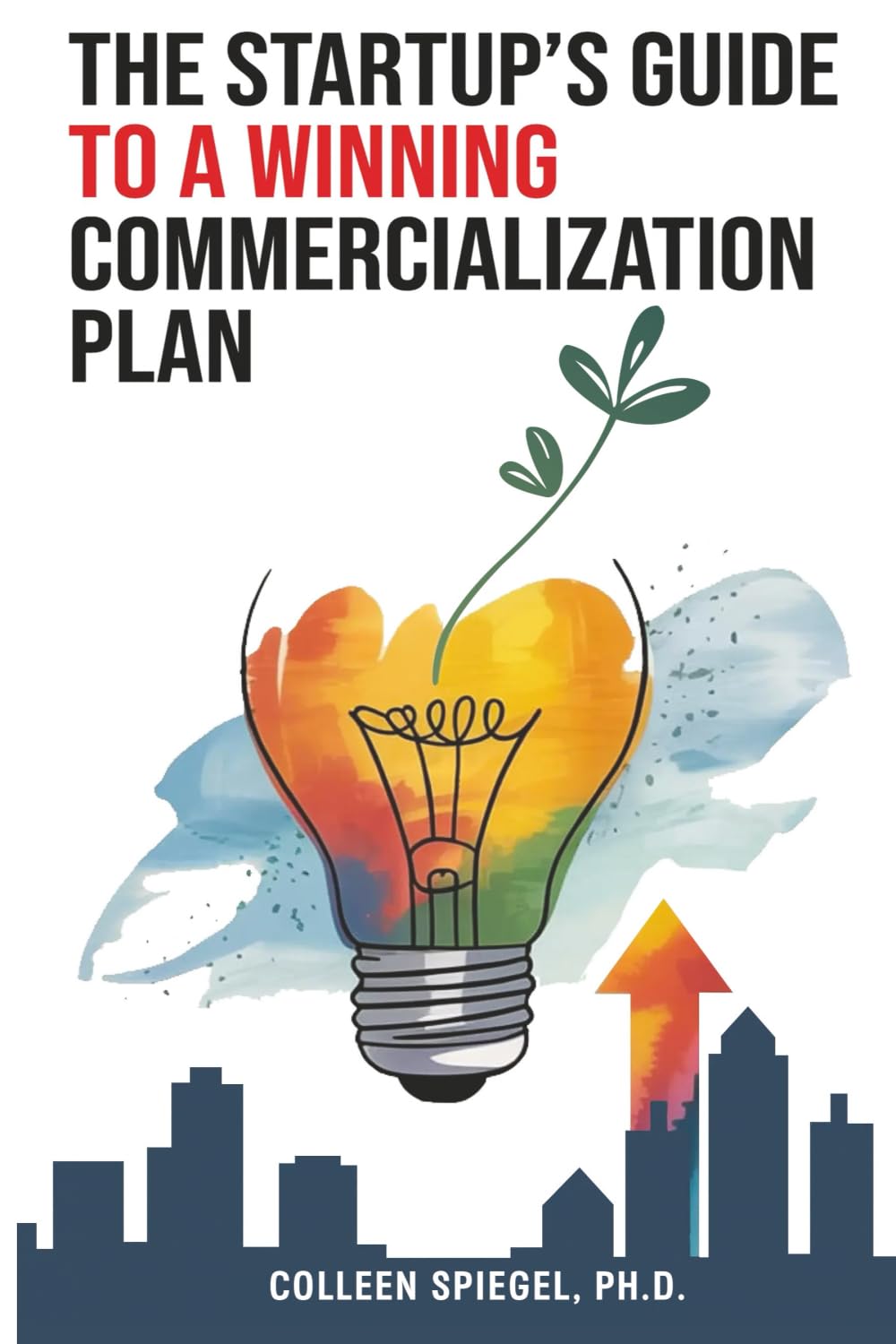
Discover the Path to Profitable Commercialization
After ten years of reviewing SBIR proposals for NSF, DOE, and NIH — and advising over 175 deep-tech startups — I can tell you the section that most consistently separates funded proposals from declined ones. It is not the technical section. Technical teams are usually strong. It is the commercialization plan. Reviewers want to see that you understand your market, your customers, and your path to revenue. Investors want to see that your technology has a viable business behind it. Federal agencies want to see that their funding will lead to a product that actually reaches the market. This guide gives you the complete framework to build that case — clearly, credibly, and compellingly.
WHAT IS INSIDE — 14 CHAPTERS:
📋 Chapter 1 — Creating Your Commercialization Plan Why commercialization planning matters — and what separates startups that succeed from those that do not. 🏗️ Chapter 2 — Commercialization Plan Structure How to structure and design a professional plan that works for investors, grant reviewers, and federal agencies simultaneously. 🎯 Chapter 3 — Mission Statement and Goals How to craft a mission statement that anchors your plan — and set short, mid, and long-term goals that reviewers find credible. 🌍 Chapter 4 — What Societal Problem Are You Solving? How to articulate the business opportunity behind your technology — and why starting with the problem is the key to everything else. ⭐ Chapter 5 — Your Unique Value Proposition Patents, first-mover advantage, and how to communicate what makes your approach different in a way that stops reviewers from dismissing you. 🏆 Chapter 6 — Establishing Company Credibility How to present your progress, achievements, and team in a way that builds immediate trust. 📊 Chapter 7 — What Is Your Market? TAM, SAM, and SOM — how to define your market rigorously, source credible data, and show the scale of the opportunity without overstating it. 🥊 Chapter 8 — Who Are Your Competitors? How to conduct a credible competitive analysis — and why claiming no competition is one of the fastest ways to lose a reviewer's confidence. 👥 Chapter 9 — What Does Your Team Need to Look Like? What investors and reviewers look for in a management team — employees, contractors, consultants, advisors, and partnerships. 💰 Chapter 10 — What Is Your Business Model? Pricing, markup, economy of scale, recurring revenue, and customer acquisition — the complete business model framework. 📈 Chapter 11 — Calculating Your Business Financials Revenue projections, net profit, margin, scenario analysis, and the financial language that signals business sophistication. 💵 Chapter 12 — Do You Need Investment or Grants? How to identify how much capital you need, present it credibly, and choose between investment and non-dilutive funding. 🚪 Chapter 13 — What Is Your Exit Plan? Types of startup exits, how to prepare for them, and why investors want to know your answer before you do. 📝 Chapter 14 — Summarizing Your Commercialization Plan How to write an executive summary that makes the entire case in one page — the section every reviewer reads first. EVERY CHAPTER INCLUDES: ✅ Real-world founder stories that illustrate what works and what does not ✅ Worksheets and assignments so you build your plan as you read ✅ Specific guidance for SBIR, STTR, investor, and partner audiences WHO THIS IS FOR: → Deep-tech founders preparing an SBIR or STTR proposal → Researchers spinning out a technology from a university or lab → Technical founders approaching investors for the first time → Startups preparing for due diligence or a board presentation → Anyone who has had a proposal declined and wants to know why WHO THIS IS NOT FOR: → Consumer product startups — this guide is written specifically for deep-tech and research-based companies → Founders who already have a funded, proven commercialization track record

About the Author: Dr. Colleen Spiegel
Dr. Colleen Spiegel is the founder of Semscio and a PhD engineer with over ten years of experience advising deep-tech startups through federal funding processes. She has reviewed hundreds of proposals for NSF, DOE, and NIH — giving her a rare perspective on exactly what funding agencies want to see and what causes otherwise strong proposals to be declined. She is the author of nine books on federal funding strategy, commercialization planning, and engineering — including two university-level textbooks on fuel cell technology published by McGraw-Hill and Elsevier. Her advisory work has helped startups across clean energy, medical devices, advanced manufacturing, and software secure SBIR funding, private investment, and commercial partnerships.
FREQUENTLY ASKED QUESTIONS:
Is this book specific to SBIR proposals? The framework is designed to work across multiple audiences — SBIR and STTR reviewers, private investors, strategic partners, and board members. Each chapter explains how to adapt the content for each audience. If you are preparing an SBIR proposal this guide is directly applicable. How long is the book? Approximately 305 pages including worksheets and assignments for every chapter. Is this a course or a book? It is a downloadable PDF book — not a video course. You can read it at your own pace and complete the worksheets alongside your own commercialization planning work. Do I need prior business knowledge? No. This book is written for technical founders — engineers, scientists, and researchers — who have deep domain expertise but less experience with the commercial side of building a business. Every business concept is explained clearly before it is applied. What if I have already started my commercialization plan? This book works as both a start-from-scratch framework and a diagnostic tool. Each chapter helps you identify gaps in your existing plan and strengthen the sections that reviewers scrutinize most.
Transform Your Business Today
Start your journey to successful commercialization. Download your ebook now and unlock the potential of your innovative ideas.
$29.99